Dots guide
When Habit Tracking Feels Like Pressure: A Gentler Way to Notice Time
A habit tracker can begin as support and slowly become another place to succeed or fail. There is another way to relate to time: observe it, return to the moment, and choose what matters without turning every day into a score.
Published July 10, 2026
Quick Answer
Habit tracking is useful when it helps you remember and understand a behavior. It becomes pressure when protecting the streak matters more than the reason you started, a missed day feels like failure, or logging takes you out of your life. A gentler alternative is to observe time itself: see the week, day, or minute you are in, then choose how you want to meet it.
When a Helpful Habit App Starts to Feel Heavy
Most habit trackers begin with a good intention. You want to read more, move your body, take medication, meditate, practice a language, or make room for something that keeps getting crowded out. Checking a box gives the intention a shape. For a while, that can be exactly what you need.
Then the relationship can change. You are no longer going for a walk because the air would feel good; you are going because the app says day 43 cannot become day zero. Rest feels suspicious. An ordinary interruption looks like a broken chain. Opening the tracker produces a small sense of debt before you have even decided what today needs.
This does not mean habit trackers are bad, and it does not mean you lack discipline. It means the tool has begun to substitute its measure for your original purpose. The record that was meant to support the behavior is now directing it.
How the Streak Becomes the Goal
Streaks are powerful because continuity feels meaningful. In a series of seven studies published in the Journal of Consumer Research, people were more likely to continue an activity when an intact streak was highlighted than when a broken streak was shown, even when the underlying sequence of behavior was otherwise the same. The researchers found that maintaining the logged streak can become a goal in itself.
That is excellent engagement design. It is not always excellent life design. The app can make one pattern unusually vivid while the reasons behind it fade into the background. Ten minutes of distracted practice may preserve the number, while a nourishing day off erases it. The tracker knows whether you checked in. It cannot know whether the action still serves you.
The pressure often becomes clearest after a miss. If the streak represented progress, its disappearance can feel as though the progress disappeared too. But your body, knowledge, relationships, and experience do not reset to zero. Only the counter does.
Why Tracking Can Create Guilt
Self-monitoring has real strengths. It can reveal patterns, provide concrete information, and prompt reflection. It also has costs for some people. A large study of health and wellness tracking described users who found tracking tedious, discouraging, or punitive. Research on people who stopped using personal tracking tools found that some felt guilty for abandoning the tracker itself, especially when they had used it to change physical activity.
Notice the extra obligation that appears here. There is the thing you hoped to do, and now there is also the duty to record the thing. Missing either can produce a red mark, a gap, a reminder, or a sense that you are behind. The system may be measuring behavior, but the experience can feel like it is measuring you.
A useful test is simple: when you open the app, do you become more curious about your life or more judgmental toward yourself? Data that helps you make a choice is information. Data that repeatedly turns a complicated day into pass or fail may be noise wearing the costume of discipline.
Tracking Behavior vs. Observing Time
The alternative to obsessive tracking is not drifting through life. It is changing the question. Instead of asking, "Did I complete the right actions today?" you can ask, "Where am I in time, and what deserves my attention now?"
These approaches are not enemies. You might track a rehabilitation exercise while using a time view to keep the rest of life in perspective. The important difference is whether your tool supports your attention or continually recruits it.
The Life Calendar: Perspective Without a Score
A Life Calendar represents a lifetime as a grid of weeks. Past weeks are visible, the current week has a place, and future weeks remain open. It is finite, but it is not a leaderboard. There is no perfect percentage and no chain to protect.
The grid does something a daily checklist rarely does: it gives this moment a horizon. A hard Tuesday is not your whole life. A distracted week is not a failed year. At the same time, the view gently interrupts the fantasy that meaningful things can always be postponed to a less crowded season.
Seeing life in weeks can sound severe, but the useful response is not panic. It is presence. This week is not valuable because you extracted the maximum output from it. It is valuable because it is the week in which your actual life is happening.
From a Whole Life Back to This Minute
A lifetime view provides perspective, but awareness has to return to the scale at which you can live. That is why Dots moves across three natural horizons:
- Life in weeks helps you see chapters, change, and the broad shape of a finite life.
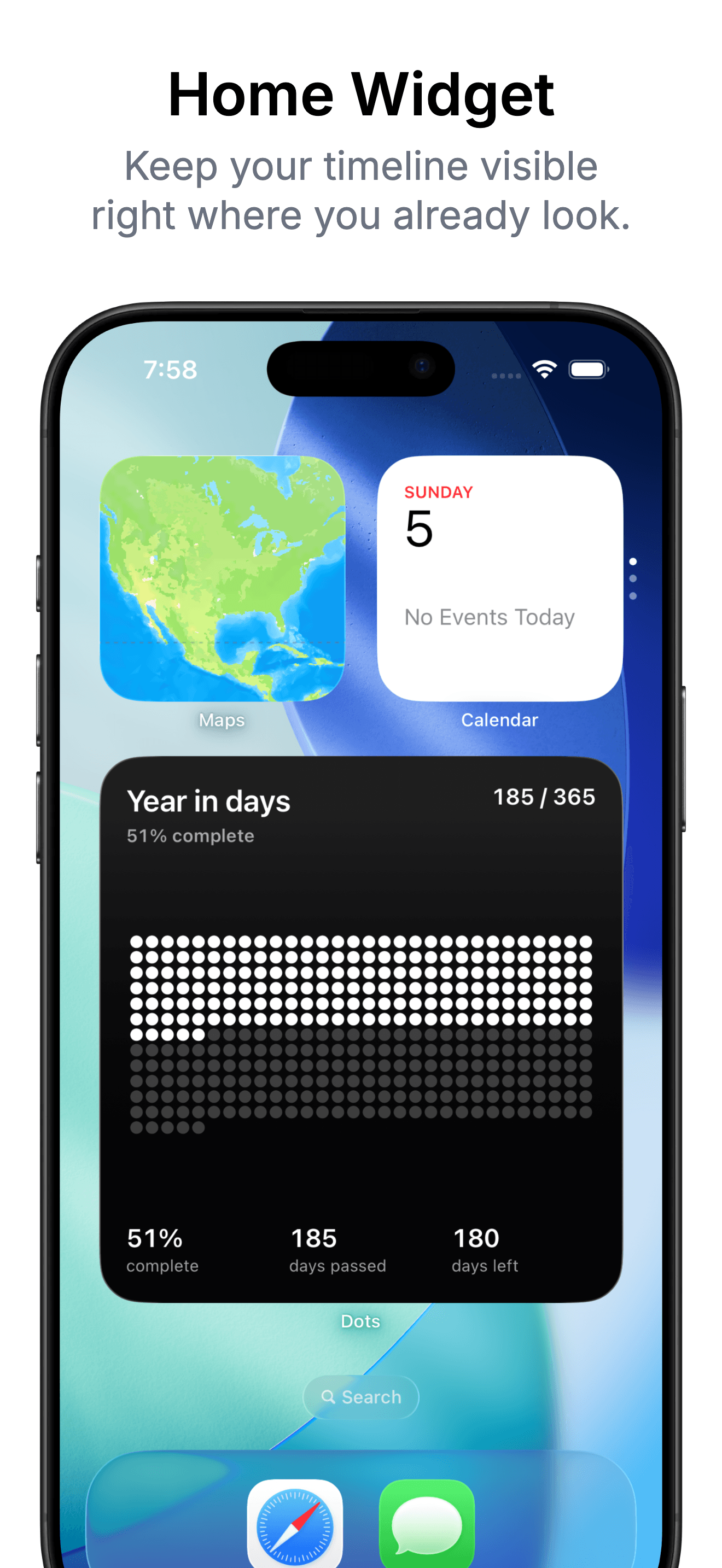
- The year in days makes the current season visible without demanding that every day be productive.
- Today in minutes brings attention back to the moment where a choice is actually possible.
This resembles one useful quality of mindfulness: awareness of present experience without immediately judging or reacting to it. Dots is not a meditation practice or a treatment. It is a quiet visual cue. The dots do not tell you whether your time was good enough. They show that it is here.
Notice time without feeding a streak.
Dots turns life in weeks, the year in days, today in minutes, and personal timelines into calm grids for iPhone. Glance, notice, choose, and return to the life in front of you.
DownloadA Gentle Reset From Habit Tracker Pressure
If your habit app has started to feel like a supervisor, try a one-week reset:
- Pause notifications. Remove the manufactured urgency before deciding whether the habit still matters.
- Name the original reason. Write one sentence about what you hoped the behavior would add to your life.
- Stop counting for seven days. You can continue the behavior, but let your own experience be the feedback.
- Notice time once a day. Look at the week, year, or day without marking it good or bad.
- Choose the next meaningful action. Ask what this moment needs, not what preserves the record.
At the end of the week, you may return to tracking, change the frequency, track only an outcome that matters, or leave the system behind. The point is to make the tool answer to your intention again.
When a Habit Tracker Is Still the Right Tool
A habit tracker remains useful when the behavior is specific, the tracking period is bounded, the data helps you learn, and a missed day remains ordinary. It can be especially practical for medication, rehabilitation, clinical instructions, or a short experiment where consistency matters and the record has a clear purpose.
The distinction is not discipline versus softness. It is instrument versus identity. Use a tracker as an instrument when it gives you information you need. Step back when its score starts telling you what kind of person you are.
The Goal Is Not a Perfect Calendar
A life cannot be completed the way a checklist can. Some days are for effort, some for repair, some for grief, play, waiting, care, or doing almost nothing. A system that recognizes only repeated output will miss much of what makes those days matter.
Observing time offers a quieter form of accountability. You see that the weeks are moving. You become aware of where you are. Then, without a badge or threat, you decide how to meet the next dot. Not perfectly. Intentionally.
Frequently Asked Questions
Why do habit trackers make me feel anxious or guilty?
A habit tracker can turn a behavior into a visible score. Once a streak becomes a goal of its own, missing a day may feel like losing progress even when the underlying habit is still healthy. That response is not universal, but it is a reasonable sign that the tool may no longer fit your needs.
Should I stop using a habit tracker?
Not necessarily. Habit tracking can be useful for a specific behavior during a defined period. Consider changing or stopping when logging creates more pressure than clarity, when you act mainly to protect a streak, or when a missed day makes you want to abandon the behavior entirely.
What can I use instead of a habit tracker?
You can use a life calendar, a weekly reflection, a simple journal, or a time-awareness app. These tools emphasize noticing how time is passing and choosing what matters next instead of recording perfect daily compliance.
How is a life calendar different from a habit tracker?
A habit tracker asks whether you completed a repeated action. A life calendar shows the time you have lived and the time ahead, often as weeks. It offers perspective rather than a score and does not require a streak.
Is Dots a mindfulness app?
Dots is a time-awareness and intentional living app, not a meditation or mental health treatment app. Its calm grids can act as visual cues to pause, notice the present, and decide what deserves your attention.
Sources and Further Reading
- Journal of Consumer Research: On or Off Track: How (Broken) Streaks Affect Consumer Decisions
- International Journal of Human-Computer Studies: Tracking feels oppressive and 'punishy'
- Proceedings of the ACM CHI Conference: Beyond Abandonment to Next Steps
- APA Dictionary of Psychology: Mindfulness
- Wait But Why: Your Life in Weeks