Dots guide
Does a Life Calendar Motivate You or Make You Anxious?
The same grid can feel like possibility to one person and a deadline to another. The difference is not whether you understand the idea. It is what the image asks your attention to do.
Published August 8, 2026
Quick Answer
A life calendar is motivating when it helps you notice what matters and make one grounded choice. It becomes unhelpful when the empty boxes feel like a threat, the filled boxes feel like a verdict, or you start treating an estimated lifespan as a deadline. If the lifetime view feels too heavy, move down to a year, season, project, or day. The right horizon is the one that creates perspective without taking away your steadiness.
One Grid, Two Honest Reactions
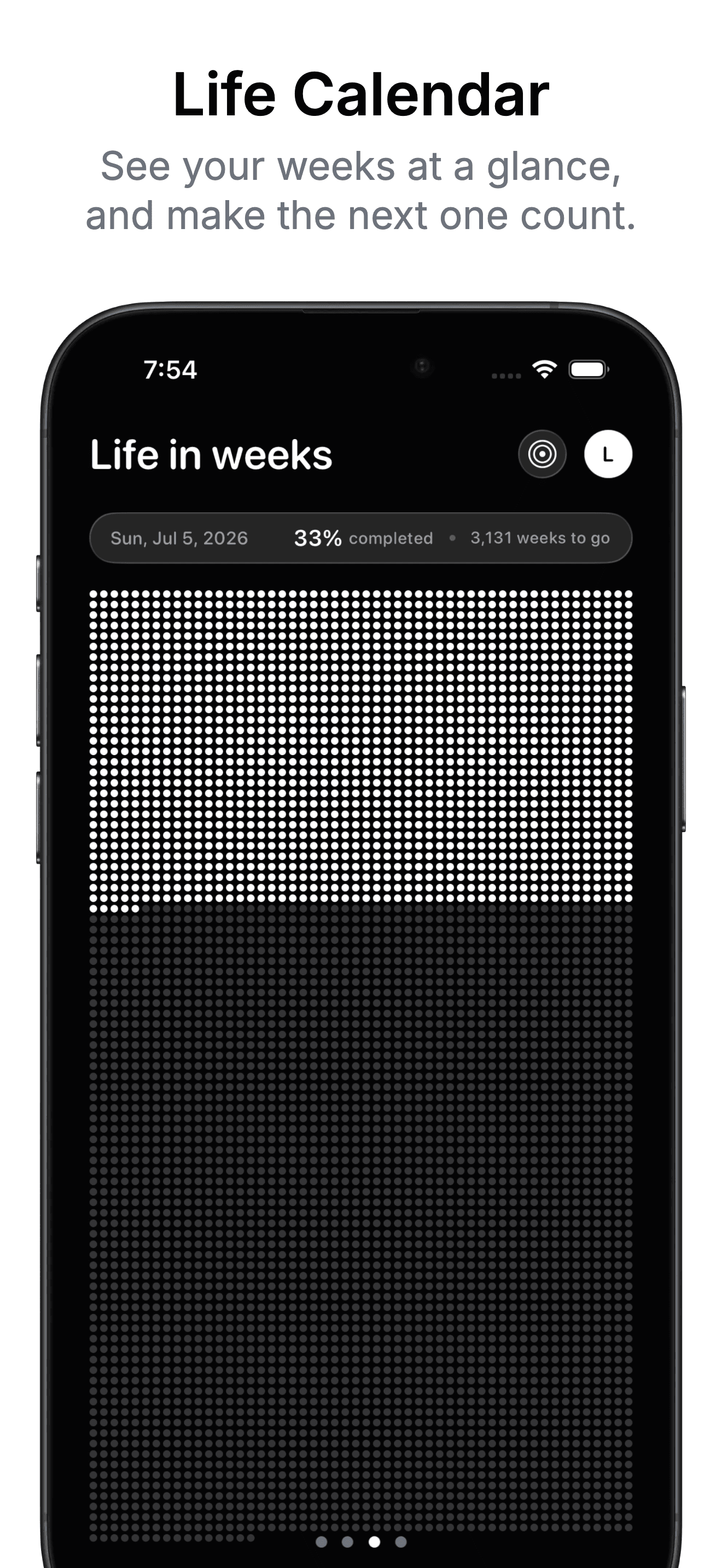
A classic life calendar compresses decades into a grid of weeks. Filled cells represent time already lived; open cells represent a possible future. The picture is simple enough to understand in a second, but people do not agree on how that second feels.
In public conversations around life-in-weeks tools, some people describe a welcome reality check. A family calendar prompted one Reddit poster to call relatives more often. Other people use the grid to reflect on chapters, mark meaningful events, or notice how much they have already created. The image turns an abstract idea—time passes—into something they can act on.
The opposite reaction appears just as clearly. Commenters call these grids anxiety-inducing, compare them to an “anxiety almanac,” or reject the suggestion that every equally sized box can represent a life of unequal moments. That reaction is not a failure to be mindful. It is information about how a particular framing lands for you.
Why a Life Calendar Can Feel Motivating
It turns “someday” into a visible scale
A week is small enough to imagine and large enough to contain real life. Seeing weeks together can make a postponed conversation, visit, or project feel concrete without prescribing what you must do.
It shows that the past is full, not gone
Filled weeks can represent people met, places lived, things learned, difficult seasons crossed, and ordinary days that formed you. The grid can be evidence of a life accumulated rather than time lost.
It interrupts autopilot
A brief glance can create enough distance from the inbox or feed to ask a better question: given the life I am in, what deserves my attention now?
Why the Same Calendar Can Feel Heavy
The grid is a model, and models hide as much as they reveal. A lifetime view can imply a precise ending that no one knows. It makes every week the same size even though a quiet afternoon with someone you love may carry more meaning than a busy month. And when it is placed on a Lock Screen, a useful moment of reflection can become an ambient demand repeated dozens of times a day.
The trouble usually begins when awareness turns into evaluation. You look at the filled area and decide you are late. You look at the open area and feel responsible for making every box exceptional. The calendar stops being a window and becomes a scoreboard.
This resembles the shift that can make habit tracking feel like pressure: the measure replaces the reason you started. A life calendar does not know whether a week was meaningful, restorative, difficult, or necessary. It only knows where the week sits on a grid.
Discomfort Is a Signal, Not a Diagnosis
A moment of unease when contemplating time is not the same as an anxiety disorder. The National Institute of Mental Health distinguishes occasional anxiety from persistent anxiety or dread that interferes with daily life. A calendar cannot diagnose, prevent, or treat either one.
You do not need a clinical reason to stop using a design that feels bad. If the grid repeatedly increases dread, disrupts sleep or concentration, or makes daily life harder, remove it and consider talking with a qualified professional about the broader feeling. The goal is not to train yourself to tolerate a wallpaper.
Use the Horizon Ladder
When a lifetime is too much to hold at once, reduce the horizon. Each step down trades some perspective for more immediacy:
- 1. Life in Weeks: Use it for rare reflection on chapters, relationships, and long direction.
- 2. Year in Days: Use it to notice the season you are in without projecting across decades.
- 3. A personal timeline: Use a known beginning and end—a semester, trip, recovery period, project, or 12-week experiment.
- 4. Today in Minutes: Use it to return to the day in front of you, especially when the distant future is not useful information.
Choose the highest rung that leaves you clearer, then stop. More scale is not more wisdom. Sometimes the most honest answer to “What should I do with my life?” is “Be present for this afternoon.”
A Seven-Day Fit Test
Do not decide whether life calendars are good in the abstract. Try one horizon for a week and observe the relationship it creates.
- Name the purpose. Write one sentence: “I want this view to help me remember…”
- Choose a calm design. Use neutral colors and the least amount of detail you need.
- Place it deliberately. A Lock Screen is frequent; a widget or occasional app view is gentler.
- Notice your first response. Do you feel oriented, grateful, hurried, numb, or judged?
- Notice the next behavior. Did you call someone, protect rest, begin something meaningful—or simply worry?
- Review after seven days. Keep it, lower the horizon, reduce the frequency, or remove it.
The Calendar Works for You
A life calendar is not a moral test. You do not become more intentional by forcing yourself to look at mortality, and you do not become avoidant by choosing a smaller view. The image has one job: help you meet time with more clarity and care.
If the full grid makes possibility visible, use it. If it makes life feel like a narrowing corridor, change the frame. The question is not whether the calendar motivates people. The question is whether this calendar, at this scale, helps you live this season better.
Find the horizon that helps.
Dots lets you move between Life in Weeks, Year in Days, Today in Minutes, and personal timelines. Start with the view that brings you back to your life—not away from it.
DownloadFrequently Asked Questions
Is a life calendar supposed to feel uncomfortable?
It can. Making a large span of time visible may create a brief sense of urgency, grief, gratitude, or perspective. The useful question is what happens next: does the feeling settle into a clearer choice, or does it keep you distressed and distracted?
What should I do if a life calendar makes me anxious?
Stop looking at the lifetime view and choose a smaller horizon such as the current year, season, trip, project, or day. Use a neutral design, check it less often, or remove it entirely. A time-awareness tool is optional; it should earn its place by helping you.
Can I use a life calendar without estimating my death?
Yes. Treat the grid as a scale for reflection rather than a prediction, or use a bounded timeline with a known end date. A year, semester, training plan, parental leave, creative project, or trip can make time visible without implying a personal expiration date.
How often should I look at a life calendar?
There is no correct frequency. Some people appreciate a quiet daily glance; others prefer a weekly or monthly reflection. Start with seven days, notice the effect, and reduce the frequency if it becomes background noise or pressure.
Is Dots a treatment for anxiety?
No. Dots is a time-awareness app, not a mental health treatment. If anxiety persists, feels difficult to control, or interferes with everyday life, consider speaking with a qualified health professional.