Dots guide
Your Life Calendar Is a Memory Map, Not a Countdown
A blank future can make a life calendar look like an expiration chart. Add the life that has actually happened, and the same grid becomes something warmer: a map of how you became yourself.
Published August 8, 2026
Quick Answer
Use a life calendar retrospectively. Mark broad chapters first, then add a few people, places, transitions, and one-sentence memories. Let colors describe the shape of your story rather than rank good and bad weeks. The grid does not need to predict your ending; it can help you see the life already gathered and remember the week you are living now.
A Countdown and a Map Ask Different Questions
A countdown asks: How much is left? A memory map asks: What happened here? Both can use the same life-in-weeks grid, but they create different relationships with it.
When only the border between elapsed and future time is visible, the eye naturally moves toward the empty space. Add chapters and notes, and the filled area gains texture. It can show the house where you grew up, the summers with cousins, a long education, the year everything changed, the job that taught you what you did not want, or the ordinary season that became home.
This retrospective use keeps appearing in public life-calendar projects. People ask for event ranges, custom colors, and notes attached to individual weeks. One recent “Existence Grid” discussion described returning to past blocks to add meaningful moments—the grid becoming a record rather than a warning. The common desire is not merely to count time. It is to give time context.
Start With Chapters, Not Achievements
The easiest way to make a memory map exhausting is to treat it like a résumé. You do not need to prove that every period produced something impressive. Start with the structures that made one part of life feel different from another:
- Homes: places you lived and the moves between them.
- People: relationships, family chapters, friendships, and communities.
- Learning: school, apprenticeships, languages, and interests.
- Work: jobs, projects, caregiving, and seasons between roles.
- Beginnings: first days, commitments, experiments, and arrivals.
- Endings: graduations, goodbyes, closures, and changes of direction.
- Body: health, recovery, training, rest, and adaptation.
- Ordinary rituals: walks, meals, games, calls, and repeated places.
A long quiet stretch is still a chapter. A difficult period is not an empty one. Rest does not need to be disguised as preparation for later productivity. The map becomes yours when its categories describe your experience instead of borrowing someone else’s definition of progress.
How to Backfill a Life Without Getting Lost
You cannot recover every week, and you do not need to. Build the map from broad to specific:
- Draw the large eras. Childhood homes, school, major moves, relationships, work, and the present.
- Choose five anchors. Pick moments you can place with confidence: a birth, graduation, move, first day, trip, loss, or decision.
- Add ranges before dots. “Living in Montreal” may be more informative than dozens of isolated events from those years.
- Write one sentence. Capture the detail that a date alone cannot hold.
- Stop while it still feels alive. Leave the unfinished map available for another day.
Approximate dates are allowed. Family photos, old calendars, messages, and maps can help, but precision is not the point. “Late summer, around the time we moved” may be the honest shape of a memory. A personal map can preserve uncertainty instead of inventing certainty.
A Note Can Hold What a Dot Cannot
A dot says when. A short note says why it mattered. Keep it small enough that reflection does not become another logging obligation. Try one of these prompts:
- One scene I want to remember from this week is…
- The person, place, or practice that shaped this week was…
- This week changed when…
- Something ordinary that felt like my life was…
- I hope my future self remembers…
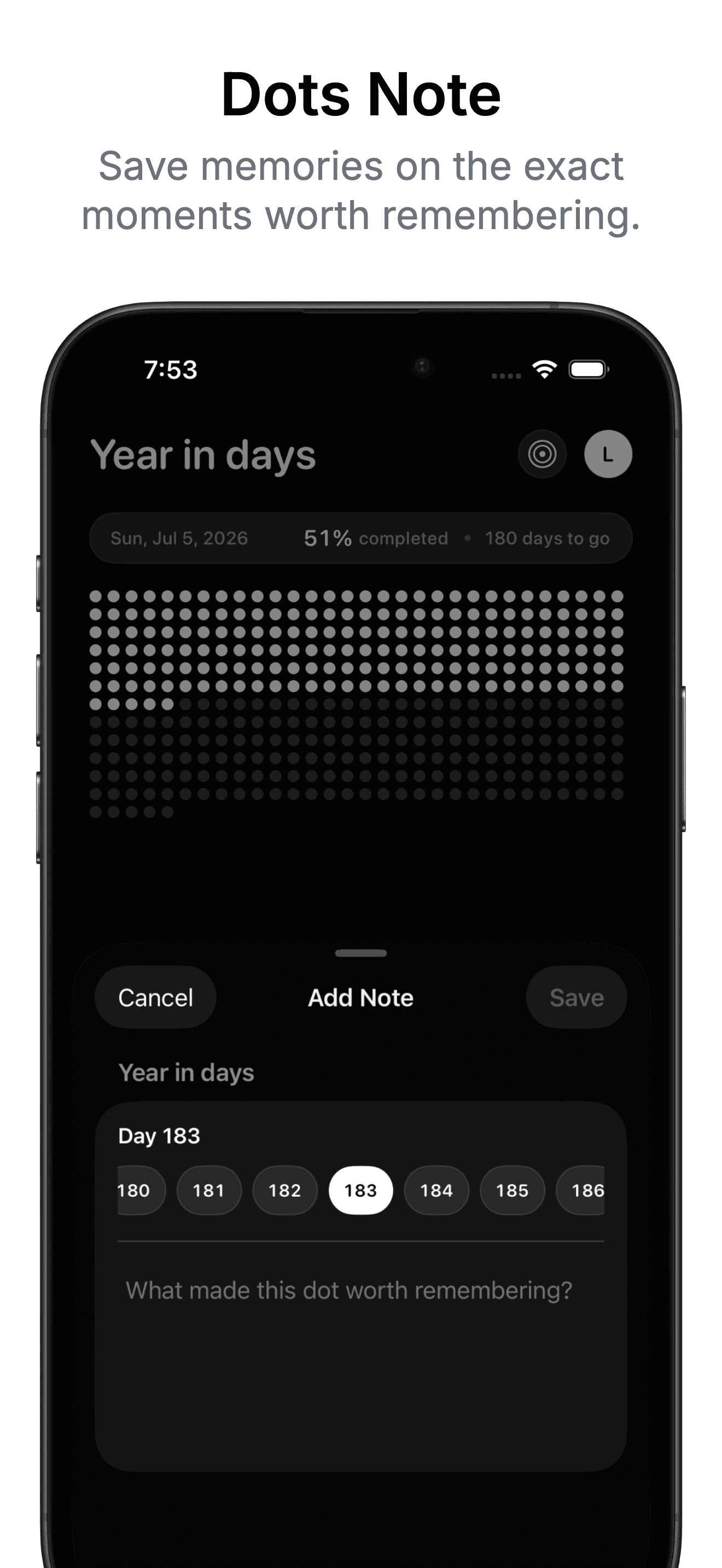
Dots lets you attach a short reflection to a meaningful dot without publishing it to a feed. Write for recognition, not performance.
Use Color as Language, Not a Rating
Red for bad and green for good sounds efficient until you try to apply it to an actual life. Important seasons are usually mixed. A demanding year may also contain a beloved friendship. A joyful move may include loneliness. A recovery may be painful and deeply meaningful at once.
Give colors descriptive jobs instead: places, people, education, creative work, health, travel, family, or transition. Use one accent for moments you want to find again. Leave some weeks uncolored. The goal is legibility, not a verdict.
Keep the Future Light
A memory map can include the future, but it should not pretend the future is already written. Add a few known dates or intentions: the visit already booked, the semester end, a hoped-for sabbatical, the project window you chose. Let the rest remain open.
If the open grid begins to feel like pressure, use a shorter personal timeline or read the guide to finding a life-calendar horizon that helps. Empty space does not mean you owe the future an extraordinary performance. It means you have not lived it yet.
A 30-Minute Memory-Map Practice
First 10 minutes
Mark three to six broad chapters. Do not research dates yet.
Next 10 minutes
Add five anchor moments and one sentence to each.
Final 10 minutes
Look at the whole map. Name one pattern you appreciate and one thing you want to protect in the chapter happening now.
Then close it. A useful memory practice returns you to life with more affection for it. The map can grow slowly, one meaningful dot at a time.
Give your weeks a little context.
Dots lets you attach a private reflection to a meaningful dot, shape personal timelines, and keep the whole story quiet until you choose to share a moment.
DownloadFrequently Asked Questions
What is a life-calendar memory map?
It is a life-in-weeks grid used as a personal timeline. Instead of focusing on an estimated number of weeks remaining, you mark chapters, transitions, people, places, and short notes that help the past become visible.
Do I need to remember the exact week of every event?
No. Begin with years or seasons, use approximate dates when needed, and leave gaps. A memory map is a reflection tool, not an official record. Honest uncertainty is better than false precision.
What should I write in a weekly note?
One sentence is enough. Record something you want your future self to remember: a small scene, a person you spent time with, a change you noticed, a difficult truth, or something ordinary that felt like yours.
Should I mark difficult periods too?
Only if doing so feels useful and safe. A truthful map can include grief, illness, uncertainty, rest, or recovery without turning them into failures. You control the level of detail and can leave any period unmarked.
Is a digital life calendar better than a paper one for memories?
Paper offers a tactile, lasting object. A digital calendar is easier to revise, recolor, carry, and annotate over time. The better format is the one you can revisit without making the practice burdensome.