DancePro guide
How to Clean Dance Choreography
Learning the order of the steps is only the first draft. Cleaning is the process of making timing, shapes, transitions, and movement quality intentional enough that the choreography reads clearly from beginning to end.
Published September 5, 2026
Quick Answer
To clean dance choreography, stop running the whole routine and review it in four separate passes: timing, shapes, transitions, and texture. Use a short video loop, compare one phrase with the reference, and record yourself from a consistent angle. Fix weight placement and timing before small visual details, reconnect the corrected phrase to its neighbors, and finish with full runs that preserve performance quality.
What Does Cleaning Choreography Mean?
In dance, cleaning means refining a routine after the basic sequence is known. For a soloist, the goal is clarity and consistency. For a group, it also means agreement: performers share timing, directions, levels, spacing, shapes, and dynamics unless a difference is choreographed intentionally.
Clean does not mean robotic or identical in every style. Groove, breath, rebound, suspension, and personal performance can remain alive. Cleaning makes choices readable; it should not erase the movement quality that gives the dance meaning.
Pass One: Clean the Timing
Choose a short phrase and identify its anchors: where the movement begins, which counts carry accents, and where the body arrives. Clap or speak the rhythm, mark the weight changes, then perform the phrase while listening for those landmarks.
On video, compare events rather than impressions. Did the foot land with the beat? Did the arm begin before the lyric or finish on it? Timing includes the journey between counts, not only frozen endpoints.
Pass Two: Clean Shapes and Pathways
Start and end positions
Pause at important pictures and compare facing, level, base of support, arm lines, hands, gaze, and the relationship between body parts.
Size and direction
Notice whether your movement travels as far, reaches the intended diagonal, or becomes unintentionally small when speed increases.
Pathway
A matching final pose can hide a different route. Watch how the arm circles, how the torso initiates, and where the weight passes on the way.
Completion
Check whether fingers, focus, knees, and torso finish the action or begin abandoning it to prepare for the next count.
Pass Three: Clean the Transitions
Transitions are where a learned routine most often becomes muddy. Loop the final two counts of one phrase and the first two counts of the next. Find the supporting foot, direction of momentum, focus, and initiation that connect them.
Practice the seam in both directions: approach it from the previous phrase, then start directly on the preparation. Finally widen the loop. A correction that only works in isolation is not finished yet.
Pass Four: Clean Texture and Performance
Texture describes how movement happens: sharp, sustained, heavy, light, elastic, percussive, restrained, or expansive. Identify where the choreography changes quality. A phrase can be accurate in order and timing but still look flat if every action receives the same energy.
Add focus, intention, breath, and commitment after the mechanical route is secure. Then record the complete phrase without stopping for small mistakes. Performance practice includes continuing, recovering, and keeping the musical idea alive.
Fix in this order
Start with safety and pathway, then weight and timing, then shapes, then texture and performance. A perfect hand angle cannot rescue a transition that begins on the wrong foot.
A Repeatable Cleaning Workflow in DancePro
- 1. Bookmark the phrase: Name the section by its problem or musical cue so you can return without searching.
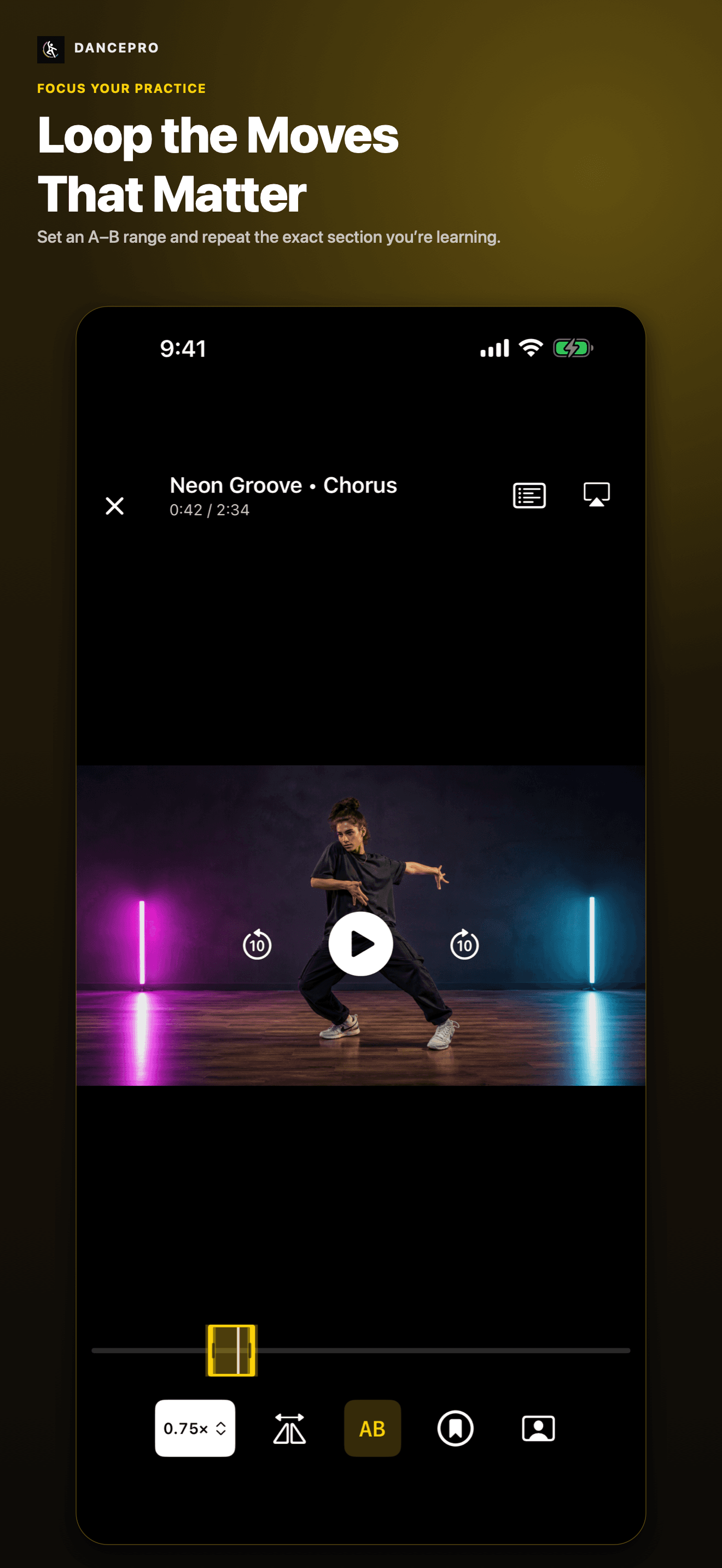
- 2. Create an A–B loop: Include a clear lead-in, the issue itself, and the resulting position.
- 3. Slow only when needed: Inspect detail below tempo, then return toward full speed so momentum and texture remain honest.
- 4. Record one pass at a time: Review timing, shapes, transitions, and texture separately rather than collecting a page of simultaneous corrections.
- 5. Reconnect and run: Widen the section and finish with a committed run that tests whether the correction survives in context.
Give the difficult four counts your full attention.
DancePro lets you bookmark, slow, loop, and record the exact phrase you are cleaning, then reconnect it to the complete routine when it is ready.
DownloadFrequently Asked Questions
What does it mean to clean a dance?
Cleaning a dance means refining known choreography so timing, shapes, pathways, transitions, spacing, dynamics, and intention are clear and repeatable. Group cleaning also aligns choices across dancers.
Why do my dance moves look messy?
Common causes include uncertain timing, unfinished weight transfers, shortened pathways, preparing too early for the next move, and trying to correct too many details at once. Record one short phrase and identify the first specific difference.
Should I clean choreography slowly?
Use slow practice to inspect order, pathway, and positions, but also clean near and at full tempo. Momentum, balance, groove, and transitions change with speed.
How do dance teams clean routines?
Teams establish shared timing, facings, levels, spacing, shapes, and dynamics, then repeat short sections and compare recordings or teacher feedback. Intentional differences should be clearly distinguished from errors.
When is choreography clean enough to perform?
A routine is performance-ready when dancers can reproduce its important choices at tempo, recover from small errors, maintain intention, and meet the required safety and group standards. Perfection is not a practical finish line.
Keep Learning
Sources and Further Reading
These references informed the guide. Dance training is individual; use qualified instruction for technique, injury concerns, and movements that are new or unsafe in your space.