DancePro guide
How to Memorize Dance Choreography Faster
Remembering choreography is not a talent that some dancers receive and others miss. It is a trainable process of organizing movement, attaching it to cues, retrieving it without help, and reconnecting the places where memory breaks.
Published September 5, 2026
Quick Answer
To memorize choreography faster, divide it into meaningful four- or eight-count phrases, give each phrase a verbal or musical cue, and learn one section until you can perform it without copying. Practice the transitions between sections, begin from several different points, and review the routine over multiple short sessions. Active recall—not continuous follow-along repetition—is what shows whether the choreography is actually in memory.
Why Choreography Disappears When the Video Stops
Following and recalling are different tasks. While a teacher or video is moving in front of you, the next action is continuously supplied. The sequence can feel familiar even though you have not practiced producing it independently. When the cue disappears, so does the apparent fluency.
Memory also fails when choreography is stored as one long chain. If the chain breaks at count twenty-three, a dancer who only practices from the beginning may have no place to re-enter. Organizing the routine into named sections creates more retrieval points.
Build a Map Before You Memorize Details
Watch the complete choreography and identify its large structure: intro, verse, pre-chorus, chorus, dance break, outro, or whatever labels fit the music. Then divide each large section into shorter movement phrases. Four or eight counts are common, but the musical idea matters more than an automatic number.
Name each phrase with a cue you can remember: “reach and turn,” “low groove,” “crossing feet,” or a lyric. The label does not need to be formal dance vocabulary. It needs to summon the movement for you.
The Recall Ladder
- 1. Copy: Follow the reference slowly enough to understand direction, pathway, and timing.
- 2. Mark: Perform a smaller, lower-energy version while saying counts, cue words, or rhythms aloud.
- 3. Recall: Hide or pause the reference and attempt the phrase alone. Let the hesitation happen instead of immediately checking.
- 4. Check: Return to the exact count where memory became uncertain. Correct only what the video actually shows you missed.
- 5. Connect: Add the final counts of the previous phrase and the first counts of the next phrase.
- 6. Vary: Start from a different bookmark, face away from the screen, or try without music so the sequence has more than one route into memory.
Use Counts, Music, Words, and Images Together
Counts provide an address inside the music. Lyrics and instrumental accents make that address memorable. Cue words preserve the order of actions, while visual images can preserve the quality: “pull through water” may be more useful than a list of joint positions.
Build the cue system that matches the phrase. You might remember “and-a-five” for a fast rhythm, a drum hit for the landing, and “open the door” for the arm pathway. There is no prize for using only one kind of memory.
Practice Transitions and Multiple Starting Points
Once two sections work separately, loop their connection. Pay attention to the final weight placement, facing, gaze, and momentum of the first phrase. Many apparent memory problems are actually incomplete endings that leave the next movement with nowhere to begin.
Then start from the chorus, the dance break, the second verse, or a named bookmark. This prevents the beginning of the routine from receiving twenty repetitions while the ending receives three. It also teaches you how to recover if you blank during a class or performance.
Review Across Days, Not Only in One Long Session
Finish practice with one no-video attempt and begin the next session the same way. The first attempt may feel worse than the final attempt yesterday; that does not mean the previous practice failed. It reveals what remained available after time passed.
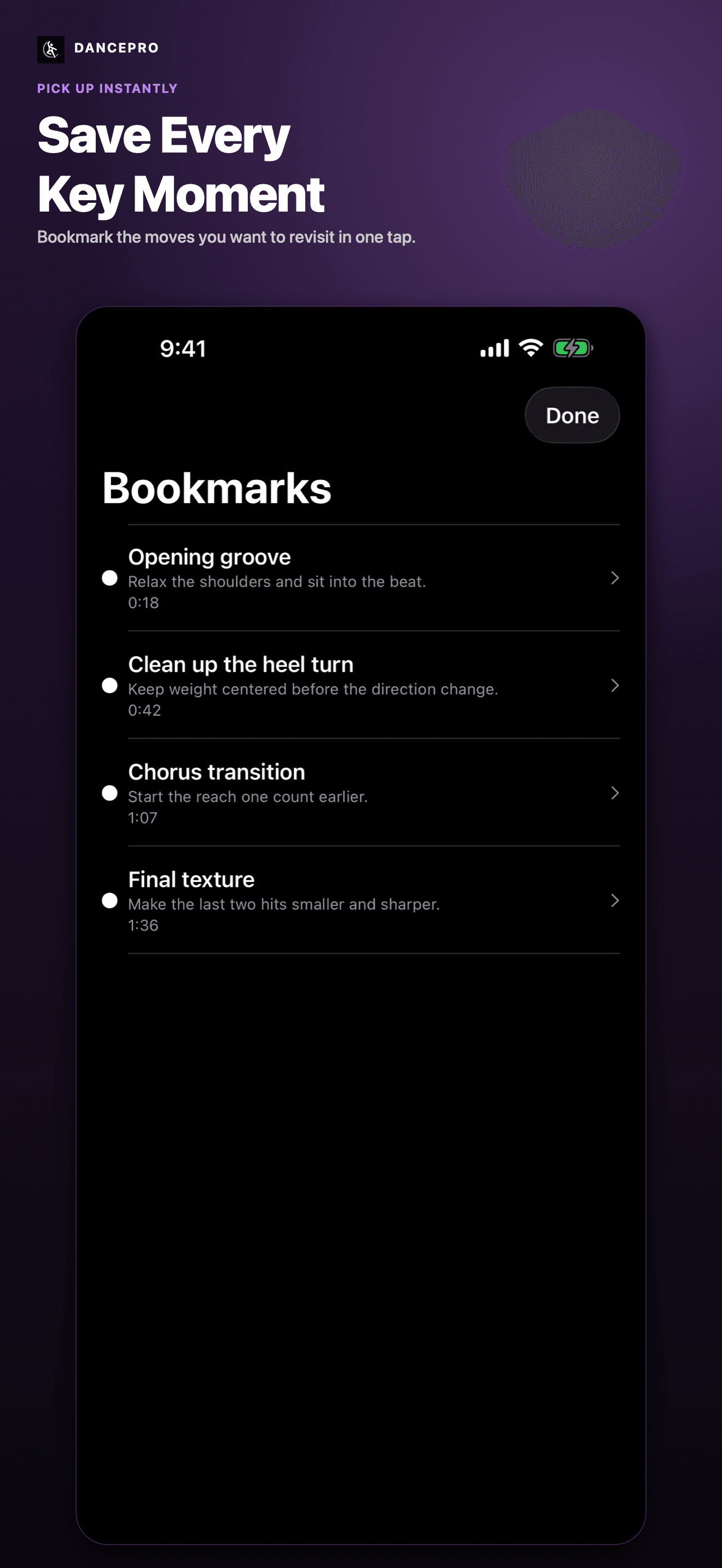
Use DancePro bookmarks to name each section and return directly to it. A short recap of older phrases before learning a new one keeps the routine balanced. Progress tracking can help you notice consistent practice, but the real measure is whether you can retrieve and perform the sequence with less assistance.
When you blank
Do not restart from count one automatically. Stay still for a moment, recall the next landmark, and re-enter there. Recovery is part of knowing choreography.
Give every phrase a place to return to.
Mark sections with named bookmarks, loop difficult connections, and keep every practice reference together in DancePro so recall—not searching and rewinding—gets your attention.
DownloadFrequently Asked Questions
Why am I so bad at remembering choreography?
Difficulty remembering choreography can come from unfamiliar movement vocabulary, overloaded attention, continuous visual following, unclear musical cues, or too few independent recall attempts. It does not prove that you lack rhythm or cannot improve your dance memory.
How many counts should I memorize at a time?
Four or eight counts are useful starting units, but phrase complexity matters. Choose the smallest section that forms a meaningful action, then connect it to neighboring phrases as soon as you can recall it independently.
Does writing choreography down help?
It can. Writing cue words, counts, directions, or corrections forces you to organize what happened. Your notes only need to trigger your own memory; they do not need to be universal dance notation.
Should I practice choreography without music?
Occasionally. No-music practice exposes the movement order and internal rhythm without relying on a song cue. Return to the music afterward because musical timing, dynamics, and phrasing are part of the choreography.
How long does it take to memorize a dance routine?
There is no dependable universal time. Length, speed, style familiarity, experience, teaching clarity, and the standard of accuracy all matter. Measure progress section by section rather than comparing your learning time with another dancer's.
Keep Learning
Sources and Further Reading
These references informed the guide. Dance training is individual; use qualified instruction for technique, injury concerns, and movements that are new or unsafe in your space.