DancePro guide
How to Practice Choreography Between Dance Classes
The purpose of between-class practice is not to reteach yourself the entire lesson. It is to keep the sequence available, preserve corrections, discover precise questions, and return ready to build on what your teacher already gave you.
Published September 5, 2026
Quick Answer
To remember choreography between dance classes, review the combination briefly on the same day, then revisit it in short sessions across the week. Use a permitted class video, divide it into named phrases, attempt each phrase from memory before watching, and record corrections in simple cue words. Practice transitions and multiple starting points, then make a list of anything that still requires your teacher's clarification.
Before You Record a Dance Class
Ask the teacher or studio whether recording is allowed, what may be included, and whether the video must remain private. Choreography, music, other students, minors, and the studio space can all create permission or privacy concerns. A class reference is not automatically yours to repost.
When recording is permitted, capture the teacher's intended version with clear framing. If possible, include counts or notes about corrections. A short, useful reference is better than a crowded clip whose direction and timing you cannot identify later.
The Seven-Day Retention Plan
- 1. Class day: Capture the map: Write the song, section names, major corrections, and the first uncertain count. Review the video once while the lesson is still fresh.
- 2. Day one: Recall before replay: Mark the combination from memory. Then check the reference and repair only the gaps you discovered.
- 3. Day two: Strengthen transitions: Practice the last counts of each phrase into the first counts of the next. Begin from at least two different sections.
- 4. Day three: Rest or review mentally: Listen to the music, visualize the sequence, or say cue words without a full physical rehearsal if recovery or schedule calls for it.
- 5. Day four: Clean one priority: Use video to check a single teacher correction, timing issue, or pathway. Record one before-and-after attempt.
- 6. Day five: Perform a larger section: Run the combination without following the screen. Continue through small mistakes and practice finding the next landmark.
- 7. Before the next class: Prepare questions: Review lightly and write concise questions such as “Which foot holds the weight on count six?” Bring uncertainty back to the teacher instead of inventing an answer.
Turn Corrections Into Short Cues
A long explanation can be difficult to retrieve while moving. Reduce each correction to a cue that preserves the teacher's meaning: “finish the reach,” “weight right,” “wait for seven,” or “eyes before turn.” Say the cue during slow marking, then let it become quieter as the correction settles.
Do not rewrite technical guidance you do not understand. Keep the original note and ask at the next class. Between-class practice should stabilize good information, not make a guess feel permanent through repetition.
Practice From More Than the Beginning
Starting at count one feels reassuring, which is why the opening often becomes stronger than everything after it. Bookmark the verse, chorus, dance break, or teacher-defined sections and choose a different starting point for each run.
If you forget, pause long enough to search your memory for the next cue. Re-enter at a landmark rather than returning to the top. This prepares you to recover in class and reveals which section needs its own review.
Know What to Leave for Class
Technique you cannot verify
If a movement depends on alignment, partnering, weight-bearing, or a skill that is new to you, wait for qualified feedback.
Unclear direction
Do not choose a side based only on what feels natural when stage position or group formation matters.
Conflicting references
If the teacher's demo and another video differ, preserve the question rather than blending two versions.
Pain or unsafe space
Stop rather than adapting a demanding movement around pain, unsuitable flooring, furniture, or insufficient room.
Organize Class References in DancePro
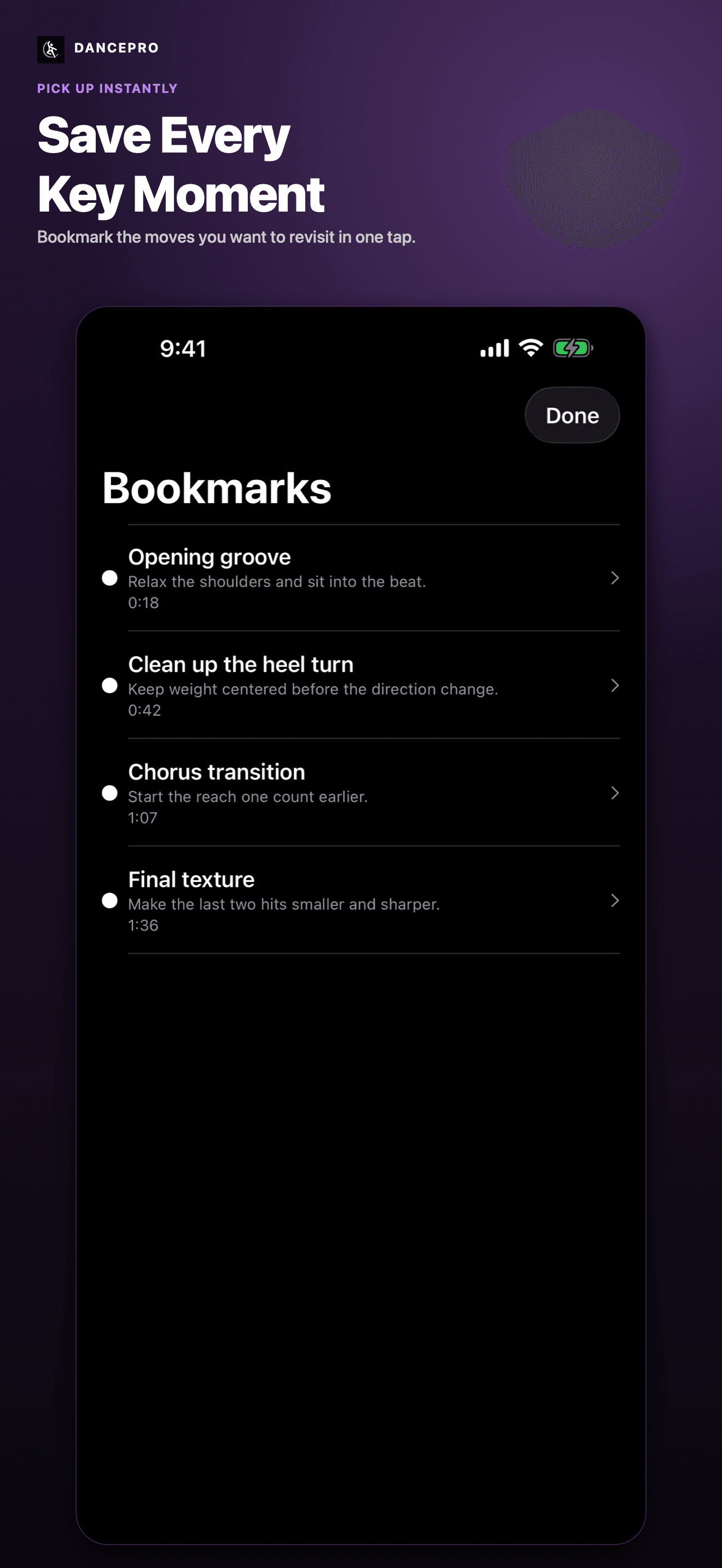
DancePro keeps permitted class videos in a practice library rather than leaving them scattered through Photos. Named bookmarks can match the teacher's sections or your correction cues, and precise loops let you review the phrase that needs attention without repeating the whole combination.
Use progress tracking as a quiet record of returning to the work. The aim is not to maximize minutes or protect a streak. It is to arrive at the next class remembering enough that new instruction has somewhere to land.
The best next-class question is specific
“Can you show the choreography again?” is broad. “After the turn on seven, is my weight on the right before the reach?” gives the teacher a clear place to help.
Come back to class ready for the next count.
Keep permitted class videos, named sections, focused loops, recordings, and practice history together in DancePro on iPhone and iPad.
DownloadFrequently Asked Questions
How do I stop forgetting choreography after dance class?
Review briefly on the class day, attempt the material from memory the next day, and revisit it in short sessions. Name sections, practice transitions, and use multiple starting points rather than always following the full video from count one.
Is it okay to record choreography in dance class?
Only with permission from the teacher or studio and consideration for everyone visible or audible in the recording. Follow restrictions on storage, sharing, music, minors, and the choreographer's work.
How soon after class should I practice?
A brief same-day review can capture corrections and unclear moments while they are fresh. The appropriate physical workload depends on what the class involved and your recovery needs; a review can be written, mental, or lightly marked.
What if the class video is mirrored?
Confirm the expected orientation before memorizing directions. Text or studio landmarks can reveal a flip, but the teacher is the best source when exact right and left sides or formations matter.
Should parents help children practice dance choreography?
Parents can help create time, space, and access to the teacher-approved reference. Avoid giving technical corrections unless the teacher has provided clear instructions, and keep practice supportive rather than turning it into a test.
Keep Learning
Sources and Further Reading
These references informed the guide. Dance training is individual; use qualified instruction for technique, injury concerns, and movements that are new or unsafe in your space.